Title: 5 W's and 1 H
Author: Peyton Joyner
Subject: Literacy
Grade
Level: 2nd Grade
State
Standard(s): ELA.RI.2.1 Ask and answer such questions as who, what, where, when, why, and how to demonstrate understanding of key details in a text.
Lesson
Goals: The students will be able to point out the questions who, what, where, when, why, and how in text.
Instructional
Methods
Anticipatory
Set
(The teacher should have all the students come sit on the carpet in front of the Smart Board.)
(The teacher should have all the students come sit on the carpet in front of the Smart Board.)
- The teacher will ask the students what a question is. Give the students a few moments to think quietly and let a few students respond. Discuss the answer they have given.
- The teacher will take out a piece of chart paper and write the words who, what, when, where, why, and how.
- Point to each word and read it aloud. Then pull up the online dictionary and tell the students we are going to define each of these words so we know how to use them later in our lesson.
- http://www.merriam-webster.com/ The teacher should let one student at a time come up and type one of the words in the search box. Listen to the pronunciation of each word and read the definition to the students. Also, read the example that is given.
- The teacher will now play a you tube video that will give students a real world understanding of what each word means. https://www.youtube.com/watch?v=vXWK1-L41f0
- After the video, ask for a student to give another example using the question who. (While the students are thinking write the definition of the first word on the chart paper.)
- Let a student answer and follow the same process for each of the questions and fill in the chart paper with the definition of each word.
- Have the students get into small groups and ask them to answer the questions based on what they are doing today. Give an example: who- your name, what- teaching a lesson on questions, when-say the date and time, etc. Let the students do the same thing in their group. (5 minutes)
- After the five minutes, let each group share their answer for who, what, when, where, why, and how. Discuss the answers with the whole class to make sure everyone is developing an understanding.
- Tell the students we are going to use this knowledge to evaluate a book. We will read the book and answer the questions who, what, when, where, why, and how.
- Tell the students answering these questions is something we do on a daily basis. We might not always realize it but we are always evaluating a situation and determining who, what, when, where, why, and how.
Recognition
“What”
Multiple means
of Representation
|
Strategic “How”
Multiple means
of Action and Expression
|
Affective “Why”
Multiple means
of Engagement
|
2.1 Define Vocabulary and Symbols
The students will look up the defintiion of each word during this phase, as well as hear the words used in multiple contexts. This is vital for the students understanding before they reach the independent phase. |
5.3 Provide ways to scaffold practice and performance
The students are slowly building their knowledge of the questions who, what, when, where, why by hearing the teacher talk about them,getting definitions from a dictionary, and getting to hear examples from the teacher as well as work in small groups to come up with examples. This is preparing them to work independently later in the lesson.
|
7.3 Reduce threats and distractions
The students are working in a group setting on the carpet right in front of the teacher so that there are no distractions of anything on their tables. The teacher works to include all students during discussion.
|
Introduce and Model New Knowledge

(Image from Google Images)
- The teacher will tell the class that they are going to read an eBook on the Smart Board called The Red Hen. As they are reading they should be thinking about who, what, when, where, why, and how according to the story.
- Before the class reads the story they are going to do a picture walk. The teacher should have a copy of the book in big book format and hold it up for all the students to see.
- Go through the pictures of the book and let the students guess who, what, when, where, why, and how based on what they see in the pictures. The students can compare their answers once they have read through the story.
- The teacher will pull up the eBook, The Red Hen and read it aloud to the students. Remind the students to focus on the who, what, when, where, why, and how of the story, http://www.gutenberg.org/files/18735/18735-h/18735-h.htm
- Once the teacher is finished reading the story, she will tell the students to pair with a partner or groups of three and buzz about the story for three to five minutes. Tell the students to discuss their answers for the questions that the class has been discussing.
- While the students are buzzing the teacher should get in the floor with the students and take anecdotal notes on which students are participating in the discussion, and if they are able to answer some of the questions.
- After the five minutes is up, have the class attention come back to whole group.
- Ask each group to answer one of the questions. If there are more than six groups then let more groups answer each specific question.
- After each group answers, discuss with the class the answer and if the students agree or disagree. The teacher should discuss whether each group is on the right track or if they need a little more help understanding the six questions.
Recognition
“What”
Multiple means
of Representation
|
Strategic “How”
Multiple means
of Action and Expression
|
Affective “Why”
Multiple means
of Engagement
|
1.1 Customize the Display of Information
The students will get to look at a big book format and then look at an eBook on the Smart Board. This gives the students a chance to see the book in two different formats.
| 6.1 Guide Effective Goal Setting Before the second phase begins, the students will be given clear goals that they should meet during this part of the lesson. They are told in the very first sentence that they are look for the six questions in the book they are reading. |
8.3 Foster Collaboration and Communication
The students are given a chance to work independently and within small groups during this phase. In the groups the students will have to communicate thoughts to one another because after group time they will be sharing ideas that came from each group.
|
Guided
Practice
(The teacher is going to have 4 stations set up around the room. This is where the students will work in small groups getting to practice answering the six questions.)
(The teacher is going to have 4 stations set up around the room. This is where the students will work in small groups getting to practice answering the six questions.)
- The teacher will have all the students return to their seats. Then the teacher is going to explain and demonstrate exactly what the students should be doing at each station. There should also be instructions posted in case the students forget. Station 1 and Station 3 will be exactly the same and Station 2 and Station 4 will be exactly the same. Every student should work at two different stations.
- Station 1 and 3: This will be the Question Game. The students can play as a whole at their station or divide into two groups (depending on amount of students.)
- There will be a deck of cards that will have a symbol or word explanation on them. For example, there could be a card with a persons face, or a location, or words that give a reason for doing something.
- A student will say do you have any "who's?" If another student has a picture with a face then they pass it over. If not, the next student goes. The object of the game is to get a card that represents who, what, when, where, why, and how. Once a student has each of the cards they will win.
- The students should keep playing the game until it is time to switch to the next station.
- Station 2 and 4: This is will be the Book Station. There will be an assortment of short picture books, pre-selected, at this station. There will also be an anchor chart. This is an example of what it would look like, except blank for the students to fill out. This copy will be at this center as a referral for what the students are looking for.

- The students can work individually or with a partner to go through a book and fill in the information on the anchor chart.
- There will also be a few audio books at the station for students who have trouble reading.
- The teacher should be walking the room working with students who seem to be struggling. This is also a good chance to see if the majority of the class is understanding or if you need to go back and provide some extra information before they move on to the independent phase.
Recognition
“What”
Multiple means
of Representation
|
Strategic “How”
Multiple means
of Action and Expression
|
Affective “Why”
Multiple means
of Engagement
|
1.2 Provide Alternatives for Auditory Information
During two of the stations, the students have the opportunity to read a short picture book or listen to an audio tape of a short picture book. This will make sure that even students who struggle with reading will be able to complete the assignment at those stations.
|
4.2 Provide Varied Ways to Interact with Materials
At two stations the students are getting a chance to develop a better understanding of the questions by using game cards. At the other stations they are interacting with books/audio tapes and anchor charts to pull out the information and write it. There are getting varied materials to use to help develop their understanding.
|
8.2 Vary Levels of Challenge and Support
Station 1 and 3 should be less challenging than station 2 and 4. This gives students a varied level of challenge and also gives the teacher a chance to support the students understanding while they are working.
|

(Image from Pinterest)
- The top image in a key.
- The students will be given a copy of the images all mixed up.
- The teacher will instruct the students to cut out each image, and paste it in the square the corresponds.
- The teacher should tell the students to lay out all their pieces before they glue anything down to make sure they have everything where they want it.
- Tell the students they should have a total of three pictures under each heading.
- The squares have a symbol and words so that the students are able to quickly figure out what each image is.
Recognition
“What”
Multiple means
of Representation
|
Strategic “How”
Multiple means
of Action and Expression
|
Affective “Why”
Multiple means
of Engagement
|
2.2 Clarify Syntax and Structure
The students will see a correlation between the words and the images that are provided on the handout.
|
5.2 Provide Appropriate Tools for Composition and Problem Solving
The students will be given scissors to cut out each square and glue to place them with the right question.
|
7.3 Reduce Threats and Distractions
The students are too the phase where they are working independently. They will know that all the work they are doing is coming from their own understanding and knowledge of this lesson.
|
Wrap-up
- Have the class leave their desk and come to the carpet.
- Tell the students to wrap-up we're going to review what we've learned today.
- Ask the students to tell you the names of the questions you worked on today and their meaning, one at a time. Let students raise their hand to say a name, and let another student give the meaning.
- Tell the students to close their eyes and think of an imaginary place.
- Where is it?
- Who is with them?
- Why are they there?
- When did they get there?
- What do they have with them?
- How did they get there?
- Now finish by having the students open their eyes, and go back to their seats for the next phase.
Recognition
“What”
Multiple means
of Representation
|
Strategic “How”
Multiple means
of Action and Expression
|
Affective “Why”
Multiple means
of Engagement
|
3.4 Support Memory and Transfer
The students are having to recall information they have learned throughout the lesson in the wrap-up. This is a great review before they move into the assessment phase.
|
4.1 Provide Varied Ways to Respond
The students are working whole group but answering individually as they feed off of each other. They are also getting to think silently to themselves.
|
8.1 Heighten Salience of Goals and Objectives
The students will show comprehension by answering the meaning of the words and by using the questions to connect them to the real world.
|
Assessment
Formative
(Informal - written)
- Tell the students this activity will be done individually to show how much they understand what we have learned today.
- They will each be given a short story that they will read. If a student needs help reading or can't read the teacher should read the short story to them.
- Then they will need to take out a sheet of paper and answer the questions: who, what, when, where, why, and how.
- The teacher should write these questions on the board.
- Tell the students they may highlight on the story if they come to a part they want to remember for later.
- Tell the students once they finish they may turn in both papers, and then pick a book from the library to read while we wait on everyone else to finish.
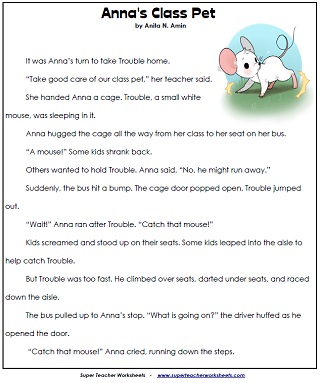
(Image from Pinterest)
Recognition
“What”
Multiple means
of Representation
|
Strategic “How”
Multiple means
of Action and Expression
|
Affective “Why”
Multiple means
of Engagement
|
3.2 Highlight Critical Features, Big Ideas, and Relationships
The students will be given highlighters so that they can highlight what they are looking for as they read. They can then go back and write down the highlighted information.
|
5.2 Provide Appropriate Tools for Composition and Problem Solving
The teacher should give the students all the materials they need to complete the assessment.
|
9.1 Guide Personal Goal Setting and Expectations
The students are told their goal of the assessment and what the teacher expects of them. They will use this to guide them as they complete the assessment.
|
Materials
- Chart paper
- Markers
- Smart Board
- Internet
- Big Book of The Red Hen
- eBook of The Red Hen
- Game cards
- Library books
- Anchor chart handouts
- Pencils
- Audio books
- Cut/Paste Worksheet
- Scissors
- Glue Sticks
- Copies of the short story
- Plain paper
- Highlighters
Recognition Networks
“What”
  |
Specific
UDL Accommodations (1.1 – 3.4)
|
||||||||||||||||||||||||||||||||||||||||||||||||
Strategic
Networks
“How”
 |
II. Multiple Means of Action and
Expression ensures that the Strategic networks of students are supported
Specific UDL Accommodations (4.1 – 6.4)
|
||||||||||||||||||||||||||||||||||||||||||||||||
Affective Networks
“Why”
 |
III. Multiple Means of Engagement
ensures that the Affective networks of students are supported
Specific UDL Accommodations (7.1 – 9.3)
|
||||||||||||||||||||||||||||||||||||||||||||||||


No comments:
Post a Comment